Trial of the Pyx
During the reign of James I, the Trial of the Pyx underwent significant royal scrutiny and ceremony. New varied denominations to support the union of the English and Scottish crowns were minted, and strict metallurgical standards were essential.
Sample coins were collected throughout the year, and The Master of the Mint was legally bound to place a fixed ratio of newly struck coins into the locked Pyx chest before any batch left the Tower of London.
The jury was drawn entirely from the Worshipful Company of Goldsmiths.
At the Goldsmith's Hall, a High Court judge summoned the Court. The coins were weighed, measured and assayed against metal trial plates to check for the correct purity and weight.
The Master of the Mint was 'on trial' during these proceedings, and if coins were found to be underweight or debased, severe punishments could be handed down.
Most images will show larger versions when clicked.

Sir Richard Martin was Master of the Mint from 1582 until his death in 1617.
One of his sons, also named Richard, served with his father, as a master-worker at the mint from 1599 to 1607.
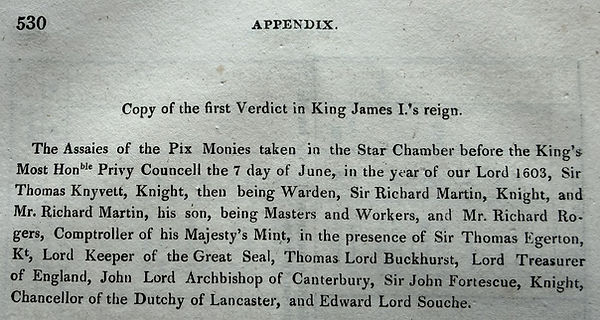
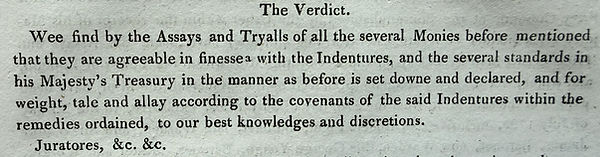
Pyx trial 7 June 1603
James came to the English throne on 24 March 1603 on the death of Elizabeth I, and the first Pyx trial of his reign on 7 June 1603, tested the last coins of the late Queen.
The extracts below show the attendance at that trial and also the verdict.
Pyx trial 22 May 1604
On 21 May 1603 James renewed the Indentures with the Master and Worker of his Mint for the coining of new monies, and one year later, the trial of 22 May 1604 tested the first coins of James, these having the thistle mint mark.
The mark was also known as the initial mark or privy mark.

First coinage Thistle
The extract below shows the amount of gold and silver tested and the fineness assessed, for the first two trials. The Pyx record does not separate silver halfcrowns from other silver coins but assesses the fineness of silver used in that period as a whole.

Additionally , the extracts in Henry Symonds article in the British Numismatic Journal, volume 9, 1912, record the actual denominations tested in each trial. The denominations included in the 1604 trial are shown below.

Pyx trial 20 June 1605
After the previous trial the mint mark Thistle was replaced by Lis.
New Indentures on 11 November 1604 had set the style of his second coinage, but mark Lis continued to be used.
There were two trials on the 20 June 1605, which separately tested the first and second coinage mint mark Lis, as shown on the extract below.


First coinage lis

Second coinage lis
Pyx trial 10 July 1606

The halfcrowns tested had the second coinage rose mark, and as a new mint mark was now used after each Pyx trial , the date ranges of each mark could be determined.

Pyx trial 30 June 1607

Since the last trial on 10 July 1606 and until 30 June 1607, the halfcrowns had the second coinage escallop mark

1 July 1607 to 23 June 1620
The catalogues record that no silver halfcrowns were minted during this period. However, the further extracts below, from Henry Symonds BNJ Vol.9 (1912) show that the same silver denominations including halfcrowns were included in the trials for grapes and coronet as were included in the 1604 trial noted above. It's not until the key mint mark was introduced after the previous trial on 17 May 1609, that the extracts record that crowns and halfcrowns were not included, and the largest denomination shown below is the shilling.
Underscoring the importance of coinage standards of other denominations, James and his son , Prince Henry of Wales, personally attended the trial held on 9 May 1611.


In October 1617, Sir Edward Villiers succeeded Sir Richard Martin as Master of the Mint, until 1623.
Pyx trial 8 June 1621
Silver halfcrowns were now produced again during the third coinage.
The first coins tested having the rose mint mark for the period from 24 June 1620 to 8 June 1621.

Third coinage obverse seeded rose

Third coinage reverse small rose

Pyx trial 3 July 1623
The coins had the Thistle mint mark from 9 June 1621 to 3 July 1623

Third coinage thistle

Pyx trial 17 June 1624
The coins had the Lis mint mark from 4 July 1623 to 17 June 1624

Third coinage lis

Pyx trial 7 July 1625
The last mint mark of the reign was now Trefoil.
During this period chief engraver, William Holle, had died and that office was then held jointly by John Gilbert and Edward Green.

Third coinage trefoil
